AI agent New
Kento Workspace
Your access to the AI agent and all Economatica services, on any device.
On July 23, 2026, Economatica introduced Kento AI at Expert XP. Kento is a productivity agent designed to accompany financial professionals in research, analysis, client service and decision-making.
It combines artificial intelligence, memory, organizational context, financial data and tools. Its aim is to reduce the time spent finding information, switching systems and repeatedly explaining the same context to different tools.
The channel changes. Kento stays with you.
Kento is Economatica's productivity agent for financial-market professionals. It talks with users, understands their organization's context, consults authorized data and tools, and helps turn information into work that is ready to use.
In practice, Kento can help prepare market briefings, research companies and assets, organize meetings, compare financial indicators, identify portfolio risks and maturities, draft summaries and messages, recover earlier context, analyze portfolios and explain financial results in clear language.
Kento was built for each organization's financial environment. It works within the products, users, permissions, tools and information sources available to that organization.
Kento supports asset managers, investment consultants, advisers, analysts, traders, bankers, wealth planners and investor-relations professionals. It can serve asset managers, advisory firms, banks, brokers, wealth and private-banking teams, family offices, research firms and corporate IR departments.
Portfolio valuation and analysis are especially relevant to advisers and consultants, but Kento was designed to support many kinds of financial work.
Kento is a Japanese given name whose meaning depends on the characters used to write it. For the brand, Economatica adopted the idea of a “wise person”: someone who learns, develops context and works alongside others. Kento is a presence that helps professionals turn knowledge into productivity, rather than the name of a technical module.
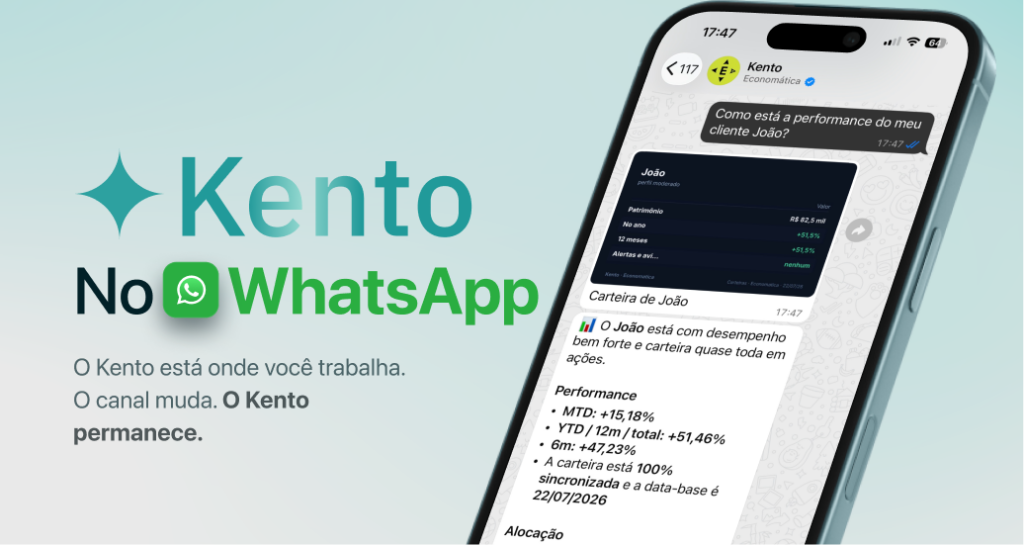
WhatsApp is central to the experience because professionals and companies already use it every day. Customers can ask Kento for a briefing, look up information, receive an alert, recover context or understand what happened in a portfolio without leaving their working channel.
An adviser might ask, “Who needs my attention first today?” Kento can prioritize clients and explain the figures and dates behind each concern. The adviser can then ask Kento to prepare a meeting with one of those clients. Kento retains the context and organizes an agenda with recent events, risks, performance contributors and likely questions.
This is the same Kento, with the organization's identity, memory, tools and policies, rather than a separate messaging bot.
Kento was designed to accompany professionals where they already work. Alongside WhatsApp, the experience includes Kento Workspace and connectors with Telegram, ChatGPT, Claude, Copilot, AWS Bedrock and Economatica Terminal. Excel integration was described at launch as a future development.
Channel and connector availability depends on the plan, contract, integration and approval of each environment. The goal is to preserve the same organizational context and permissions across channels.
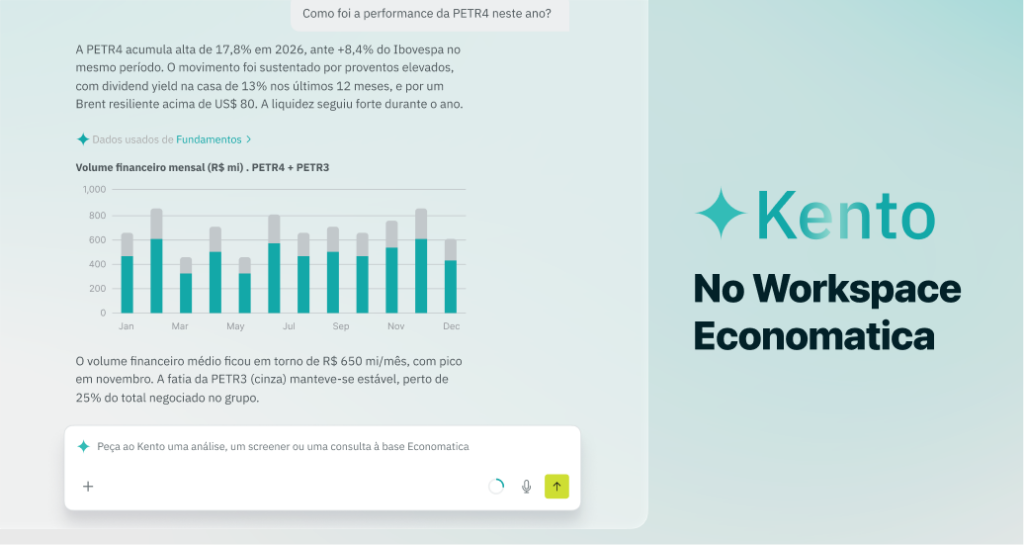
Kento Workspace became the central environment for access to Economatica solutions. Customers can reach products such as Economatica Platform and Terminal according to their licenses and permissions. Organizations can manage users, products and access in one place.
Workspace is also Kento's home. It contains the full agent experience, including memory, context, tools, artifacts, history and administration features. Economatica customers can try a free tier there before choosing a plan with more capabilities and usage.
Kento develops context over time using a customer's preferences, authorized sources, analysis methods, processes and instructions. That context is separated by organization and is not shared with other customers.
Organizational memory does not mean training a shared base model on customer data. It is controlled context restricted to that organization's environment.
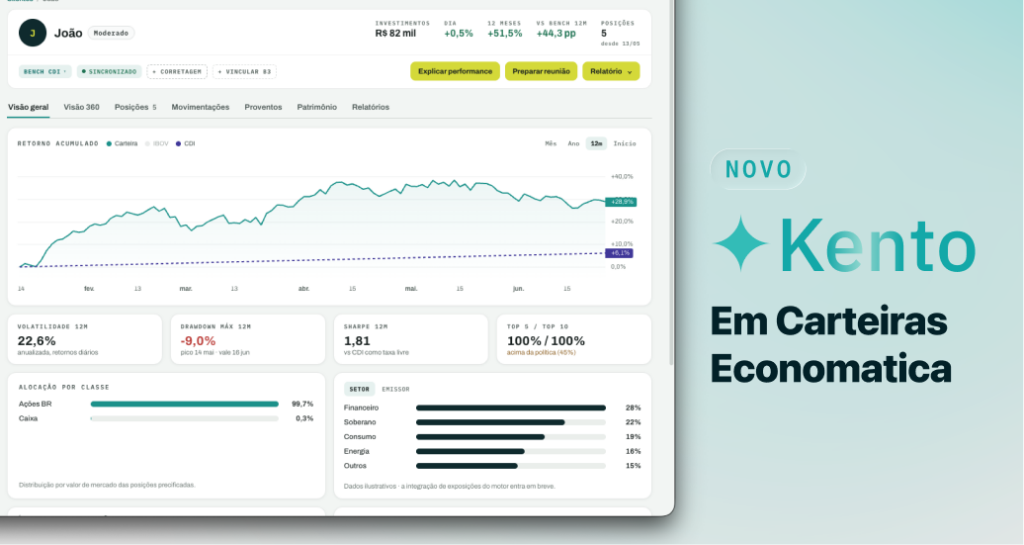
For advisers and consultants, one important use case connects Kento with Economatica Portfolios. The portfolio system consolidates positions, transactions, prices, costs, benchmarks and events needed to understand each client's investments.
Kento can then help answer questions such as: Who needs attention first? What changed across my clients? Why did this portfolio perform as it did? Where are the main risks? Is it concentrated? How does it compare with CDI and Ibovespa? Which maturities matter? How should I explain the result and prepare the next meeting?
The financial engines in Economatica Portfolios perform the calculations. Kento consults the results, organizes them and explains them in language suited to the situation. Professionals retain responsibility for decisions.
Before using private information, Kento considers the user's identity, organization, permissions, subscribed products and channel. Policies can set different levels of detail by environment: an external channel might show only a summary, while Workspace offers a more complete controlled view.
Interactions can be recorded for review and governance. The objective is greater productivity while the organization retains control over its data and processes.
Kento's commercial model is based on individual subscriptions within an organization. Advisers and consultants may purchase online, while institutional customers work with Economatica's sales team on users, products, connectors, rollout and governance needs. Existing customers can begin with the free Workspace tier.
The Expert XP presentation marked a new chapter for Economatica, connecting four decades of financial data and tools to professionals' daily work through Kento.
Explore the current offering on the Kento page.
Economatica's official Perplexity connector brings financial data and Kento tools into the research workflow professionals already use.
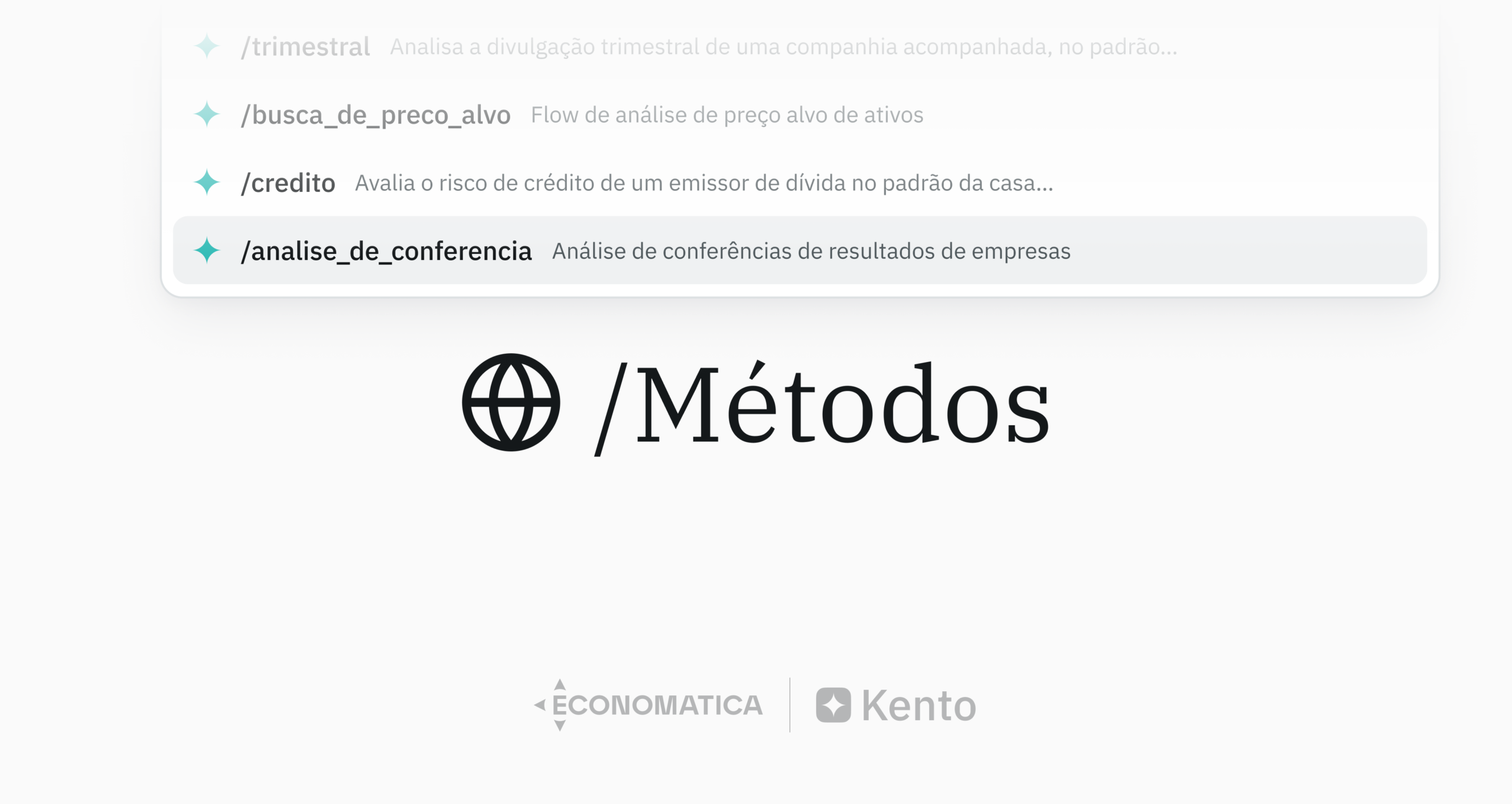
Kento Methods make a firm's own analysis standards available to every authorized team member, with versioning and checks before delivery.
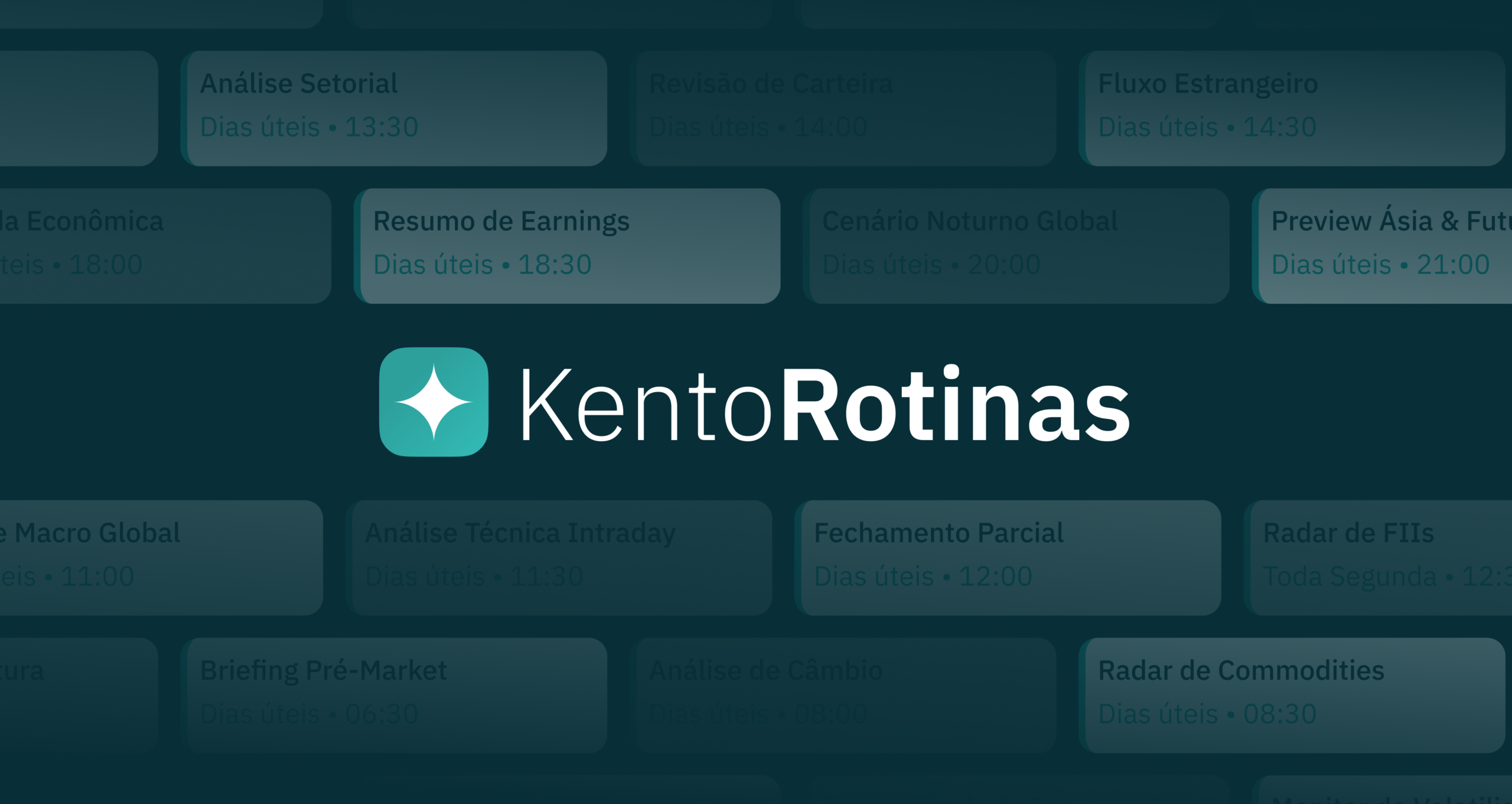
Kento Routines turn recurring financial research into scheduled briefings delivered through chat, email, WhatsApp or Telegram.
See how Economatica data and tools support research, decisions and daily work across your team.
Choose where to log in